Home | Patient questions
Dr. Trinh
Coming from Cambodia: how to get here
A practical guide for patients travelling from Phnom Penh to see Dr. Trinh in Ho Chi Minh City, Vietnam
One overland trip, one consultation, and a Khmer-speaking interpreter with you in the room. This page walks through the whole thing in order — and it is honest about the parts you have to check yourself, because those are the parts that change.
Step 1 — message before you buy a ticket
Do not travel first and hope for the best. Send a message on Messenger before you book anything. A Khmer speaker replies, and together you settle three things:
Which day the doctor can see you — so you buy your ticket for the right day, not a day you have to change.
What is hurting and for how long — so the doctor already knows your story before you walk in.
That a Khmer-speaking interpreter is arranged for your consultation.

You can send photos of your old X-ray films and your medicine boxes in that same message. It costs nothing and it saves you a wasted trip if what you need is something the doctor can already tell you by message.
Step 2 — the route: Phnom Penh to Ho Chi Minh City
You leave from Phnom Penh. Several bus companies run daily services between the two cities. Two of them publish their own journey times: Giant Ibis states "6 Hours" over a "240 km" route, and The Sinh Tourist states "7 hours" over "300 km" with multiple daily departures. Budget for most of a day door to door once the border stop is counted.
You cross at Bavet – Moc Bai. Bavet is the Cambodian side, Moc Bai the Vietnamese side, in Tay Ninh province. Moc Bai is named on Vietnam's official national tourism site among the land border gates where e-visa holders may enter and leave Vietnam.
At the border you get off the bus. Giant Ibis describes its own process this way: "When the bus arrives as the border, passengers must disembark to receive an exit stamp in their passports. The Crew Attendant will return passports to passengers as they get off the bus and collect them again when you get back on to process them with Vietnamese immigration." Ask your own operator how they handle it, because it is not the same everywhere.
You arrive in Ho Chi Minh City. Message us when you are close and we will tell you exactly where to come.
Three things we deliberately do not print on this page: ticket prices, exact bus departure times, and the opening hours of the border gate. We went looking, and the sources we could find contradict each other — we counted five different sets of opening hours for the crossing, none of them on a government page. Anything we printed would be a guess dressed up as a fact, and you would be the one standing at a closed gate. Get all three from the bus company you actually book with, on the day you book.

Flying between the two cities is the other option. Check current routes and times directly with the airlines.
Your passport and your entry paperwork
Vietnam's Ministry of Foreign Affairs publishes the visa-exemption list, and Cambodia is on it. For Cambodia the list records, in Vietnamese, that holders of an ordinary passport are exempt from a Vietnamese visa, that the passport must be valid for at least 6 months, and that the temporary stay must be no more than 30 days. It cites an agreement signed 4 November 2008, as later adjusted, in force from 1 January 2010. That page was last updated 14 March 2025.

For a consultation trip, that is normally all you need. But read the two lines below before you book, because they are where people come unstuck.
Count the months left on your passport. Six months of remaining validity is part of the rule, not a suggestion. An expiring passport is one of the commonest reasons travellers are turned back, and it is the easiest thing on this page to fix early.
If your treatment could keep you in Vietnam longer than 30 days, the exemption does not cover that. Tell us when you message so we can say whether it is likely. Vietnam's official electronic visa portal, evisa.xuatnhapcanh.gov.vn, states the e-visa is "valid for maximum of 90 days, single or multiple entry".
If you do use an e-visa, the crossing you name matters. The portal publishes a list of ports where e-visa holders are allowed to enter and leave Vietnam. Vietnam's official tourism site names "Moc Bai and Xa Mat (Tay Ninh)" among the land border gates on that list — so check that the crossing you intend to use is on it, and that you select the right one on the form.
Your bus company can refuse to board you. Giant Ibis states plainly on its own route page: "Vietnam does not offer a visa on arrival for all countries. Passengers must pre-arrange their visa otherwise they will not be able to board the bus." Whatever paperwork applies to you, have it in your hand at the bus station.

And then confirm it yourself. Immigration rules change without warning, we are a doctor's page and not an immigration office, and you are the one who will be standing at the gate. Check the current requirements with the Embassy of Vietnam in Phnom Penh before you buy a ticket — not after.
Step 3 — what to bring from your medical file
This is the part most patients get wrong, and it is the part that decides whether one trip is enough. Bring the paper. Even old paper.
Your old X-ray, CT or MRI films — the actual films or the CD, plus the written report if you were given one. Films from two or three years ago are still useful: they show the doctor how fast things have changed.
The medicines you are taking now — bring the boxes or strips themselves, not just the name from memory. If you cannot bring them, photograph every box, front and back, before you leave home.
The name of any diagnosis you were already given — written down, in whatever language it was written in. "The doctor in Phnom Penh said it was gout" is useful information.
Any blood test results you have, especially uric acid results if gout has been mentioned.
A note of what you have already tried — which places you went to, which medicines helped a little, which did nothing. This stops you being sent down a road you have already walked.
If you had surgery before — any operation note or discharge paper, even a photo of it on your phone.
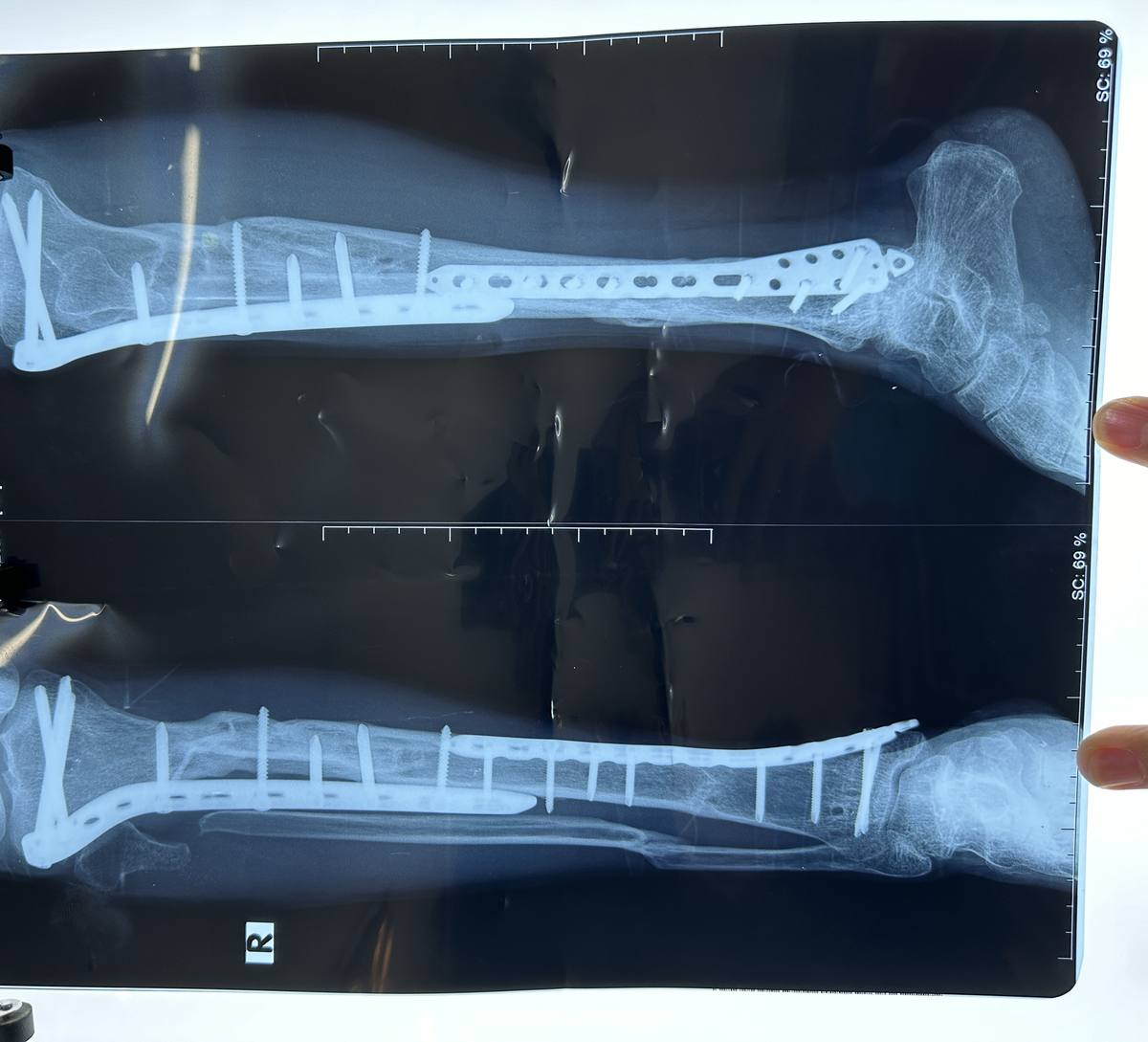
X-ray film being read
Bring your films — the doctor reads them with you and explains what is on them
Reading the imaging you bring is included in the 10 USD consultation. There is no extra charge for it.
Bringing your medicines across the border
This matters for joint and gout patients, who often travel with several medicines. Vietnam's current pharmacy decree - Decree 163/2025/ND-CP, in force since 1 July 2025 - allows an arriving traveller to bring medicine for their own treatment without an import licence, within limits on quantity.

Controlled medicines are the tightest case: no more than a 7-day supply for narcotic medicines, and no more than a 10-day supply for psychotropic medicines or medicines containing precursors, counted by the dosage written on your prescription. Vietnam Customs publishes the same two figures. Above those amounts an import licence is required, so ask the embassy well before you travel.

Whatever you bring, the paperwork rule is the same. Medicines should be in packaging that shows the drug name, the active ingredients, the strength, the content and the expiry date, and they should be accompanied by a prescription or outpatient record giving the patient's name and age, the drug name, strength and volume, the quantity or number of days, the dosage, and the prescribing doctor's full name, signature and the address of where they practise. That list is the one written into the decree itself.
In plain terms: bring the original boxes with the labels on them, and bring the prescription paper. Do not decant your tablets into an unlabelled bag. On declaring them, we will not tell you a rule we cannot stand behind: medicines are not on the list of goods that Vietnam Customs publishes as requiring the written traveller declaration, but for personal medicine the law does require the prescription to be handed over at clearance, and the Vietnamese embassy advises declaring controlled medicines. Declaring is the safe course - it costs you nothing and removes the argument. Rules change; confirm with the Embassy of Vietnam in Phnom Penh before you travel.
Which day to come, and how to plan the hours
We will not guess a day for you on this page. Message us on Messenger and we will tell you which day the doctor can see you, and what time to aim for. Then buy your ticket for that day. Doing it in that order is the single biggest difference between one trip and two.
Travel so that you arrive with hours to spare, not minutes. A consultation you are rushing through is a consultation half done.
If walking or standing is painful, come with someone. You will be getting on and off a bus and standing in a queue at the border.
If the doctor may suggest a procedure on the same visit, tell us when you message so the day can be planned for it rather than sending you home to come back.
Keep your phone able to open Messenger on the road, so you can reach us if the bus is delayed at the crossing.
What it costs
Consultation with the doctor
Full package, no extra charge
10 USD
Joint injection, if the doctor suggests one
Full package, no extra charge
From $190
* The 10 USD consultation covers the examination, the doctor's advice and reading the imaging you bring. The price of any treatment depends on your actual case and is told to you in US dollars before you decide. Nothing is transferred in advance — you pay at the reception counter after you have met the doctor.
Your travel costs are separate and are not paid to us. Bus or plane tickets, food and a place to sleep are paid to the bus company, the airline or the hotel. Fares change, so check the current price directly with the operator you choose before you travel — do not rely on a price you read on any website, including this one.
You will not have to explain your pain in a language you do not speak
Messages to the Messenger page are answered by a Khmer speaker.
A Khmer-speaking interpreter is arranged for the consultation itself, so you can describe the pain in your own words and hear the doctor's answer in your own language.
Ask for this when you message. It is part of the 10 USD consultation package, not an add-on you pay for.
Before you leave home — the short list
1.
Messaged on Messenger and agreed a day.
2.
Passport in hand, and its remaining validity checked against the current Vietnamese entry rules.
3.
Entry paperwork sorted — see the section above, and confirm it on the official Vietnamese immigration site before you travel.
4.
Old films, reports and blood tests packed.
5.
Medicine boxes packed, or photographed front and back.
6.
Enough US dollars for the consultation, and a phone that can open Messenger on the road.
7.
Someone with you if walking is hard — the trip involves getting on and off a bus and standing in a queue at the border.
Frequently asked questions
Q: How do I get from Phnom Penh to Ho Chi Minh City to see the doctor? A: Most patients travel overland through the Bavet - Moc Bai border crossing. Several bus companies run daily services between the two cities. Two operators publish their own journey times for this route: Giant Ibis states 6 hours over 240 km, and The Sinh Tourist states 7 hours over 300 km. Add the border stop on top, and schedules and fares change, so check them directly with the bus company before you travel.
Q: Do I need a visa to enter Vietnam? A: Vietnam's Ministry of Foreign Affairs publishes a visa-exemption list which records, for Cambodia, that holders of an ordinary passport are exempt from a Vietnamese visa, that the passport must be valid for at least 6 months, and that the stay must be no more than 30 days. That list cites an agreement in force since 1 January 2010 and was last updated 14 March 2025. For a consultation trip that is normally all you need. If your treatment could keep you in Vietnam longer than 30 days, the exemption does not cover it - Vietnam's official e-visa portal at evisa.xuatnhapcanh.gov.vn states the e-visa is valid for a maximum of 90 days, single or multiple entry. Rules change, so confirm your own situation with the Embassy of Vietnam in Phnom Penh before you buy a ticket.
Q: Can I cross the border at Bavet - Moc Bai? A: Moc Bai, in Tay Ninh province on the Vietnamese side, is named on Vietnam's official national tourism site among the land border gates where e-visa holders may enter and leave Vietnam. It faces Bavet on the Cambodian side. We do not publish the gate's opening hours, because the sources we could find disagree with each other - check them before you set out.
Q: What happens at the border while I am on the bus? A: Giant Ibis describes its own process this way: passengers must get off the bus at the border to receive an exit stamp in their passports, the crew attendant returns passports as passengers get off and collects them again on re-boarding to process them with Vietnamese immigration. Operators differ, so ask the company you book with how they handle it.
Q: What medical records should I bring with me? A: Your old X-ray, CT or MRI films and any written report, the medicines you are taking now in their original boxes, the name of any diagnosis you have already been given, any blood test results, and a note of what you have already tried. Reading the imaging you bring is included in the 10 USD consultation, at no extra charge.
Q: Can I bring my own medicines into Vietnam? A: The Embassy of Vietnam states that individuals entering Vietnam may bring personal medicine for their own medical treatment without an import licence. Controlled medicines are limited to no more than a 7-day supply for narcotic medicines and a 10-day supply for psychotropic medicines or medicines containing precursors, must be declared, must be labelled with the drug name, active ingredients, concentration, content and expiry date, and must come with a prescription. Bring the original boxes and the prescription paper.
Q: How much will the visit itself cost? A: The consultation is 10 USD as a full package, covering the examination, the doctor's advice and reading the imaging you bring. A joint injection starts from 190 USD. The price of any treatment is told to you in US dollars before you decide, and you pay at the reception counter after you have met the doctor. Your bus ticket, food and accommodation are separate and are not paid to us.

Message us now
There is a Khmer speaker who will reply to you

Message on Facebook Messenger
Ho Chi Minh City, Vietnam
More pages
About Dr. Trinh Patient questions Knee pain Gout Back pain Herniated disc Shoulder pain Neck pain Home